Checks
The checks are the standard's oracle. Every principle names at least one check that tests it, and CI fails if one names none.
Each check keeps one order: a program verifies what a program can verify exactly, for free; a model works only where meaning is at stake; judgment takes what no model should settle. Every check runs in polynomial time and space, and none costs money: the one paid backend exists but is off.
Tiers, and how often they run
| Tier | Needs | Runs | Finds |
|---|---|---|---|
| program | the Python standard library | every push | errors, warnings, questions |
| meaning | sentence embeddings (fastembed) | every push, model cached | questions |
| syntax | a parser (spaCy) | weekly, and on demand | warnings |
| judgment | a person, or a model if given | every push: listed | answers |
| Folder | Holds |
|---|---|
| program/ | the checks that need no model: paths, folders, links, size, outline, copies, terms, shapes, sentences, figures, stylesheet, citations, bibliography keys, history |
| figures/ | the program-tier checks that read figures: drawn or typed, described, in step with their Graphviz source, readable on a phone |
| meaning/ | the checks that compare meaning: paraphrased copies, page mode, name against content, section cohesion |
| syntax/ | the checks that read a parse: dependency length, clause nesting, links between sentences |
| framework/ | what every check is built on: the interface, the prose units, the judgment backends |
| run.py | the one entry point |
| config.toml | every threshold, tagged PROVISIONAL where it is a convention, and the default tiers |
| test_checks.py | the checks' own oracle: a planted violation per check |
| test_framework.py | the runner, the config, the judgment step, and each way a run can fail |
| test_tiers.py | the meaning and syntax tiers' planted cases, skipped when their library is missing |
| test_properties.py | properties every input must keep, tried on generated inputs from a seeded source |
What a check's findings can be trusted for, and what it costs, is said once, in its docstring. Each tier's README shows it in the Guarantee column, and a test fails when a check does not say. Which principle each check serves is said once, on the principle's Check: line; principle-coverage holds every principle to naming at least one registered check.
Kinds of finding
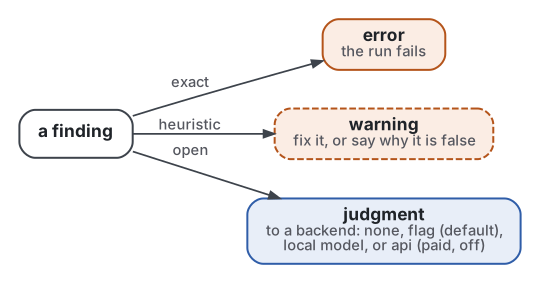
Graphviz source
digraph findings {
  graph [rankdir=LR, nodesep=0.4, ranksep=0.5, bgcolor="white", pad=0.2, fontname="Inter"];
  node  [shape=box, style="rounded,filled", fontname="Inter", fontsize=13, margin="0.2,0.1", penwidth=1.5, fontcolor="#1F2328"];
  edge  [fontname="Inter", fontsize=11, color="#3D434B", fontcolor="#55575F", penwidth=1.3, arrowsize=0.8];
  F [label=<<b>a finding</b>>, fillcolor="#FFFFFF", color="#3D434B"];
  E [label=<<b>error</b><br/><font point-size="11" color="#55575F">the run fails</font>>, fillcolor="#FBEDE4", color="#B4541A"];
  W [label=<<b>warning</b><br/><font point-size="11" color="#55575F">fix it, or say why it is false</font>>, fillcolor="#FBEDE4", color="#B4541A", style="rounded,filled,dashed"];
  J [label=<<b>judgment</b><br/><font point-size="11" color="#55575F">to a backend: none, flag (default),</font><br/><font point-size="11" color="#55575F">local model, or api (paid, off)</font>>, fillcolor="#E8EEF8", color="#2F5DA8"];
  F -> E [label=" exact"];
  F -> W [label=" heuristic"];
  F -> J [label=" open"];
}| Backend | What happens | Cost |
|---|---|---|
none |
questions dropped | free |
flag (default) |
questions written to checks/out/needs-judgment.md for the person or agent already at work |
free |
local |
each question sent to a model on this machine through an OpenAI-compatible endpoint, set only by READER_ERGONOMICS_LOCAL_URL and READER_ERGONOMICS_LOCAL_MODEL |
free, local |
api |
the same protocol to a paid provider (READER_ERGONOMICS_API_URL, _KEY, _MODEL); refuses to run unless [judgment.api] enabled = true |
paid, off |
A model's answer is recorded as advice next to its question; it never fails the run. An answer that settles a question goes in checks/judgments.toml, committed with the repository, with the fingerprint of the file it concerns: the question stays answered until that file changes. Open questions are also written as entries to fill in, in checks/out/judgments-to-answer.toml. An answer quotes what its reason rests on, and judgment-quotes checks that each quote is in the answered file: a reason copied from another file's answer then fails.
Use
python3 checks/run.py .                    # tiers from config
python3 checks/run.py . --tiers program    # no model at all
python3 checks/run.py . --out verdicts.txt # also write one line per finding, then summary and exit status
python3 checks/run.py path/to/repo         # another; its config wins
python3 checks/run.py . --online --only references
python3 -m unittest discover -s checks     # test the checks
pip install -r checks/meaning/requirements.txt   # the meaning tier
pip install -r checks/syntax/requirements.txt    # the syntax tier
--out FILE writes kind check path:line message per finding (errors, warnings, and the judgment questions still open), then summary errors=N warnings=N judgments=N seconds=S tiers=... and exit N, replacing the last run's file. Standard output is unchanged.
A tier whose library is missing is skipped with a notice, never failed. .github/workflows/checks.yml runs the program and meaning tiers on every push and pull request. It runs the syntax tier and the online references once a week.
What other tools already check
The tools were searched on 2026-10-28, when 31 checks existed:
- no counterpart, for 11: none of the tools found checks overview first, terms defined across files, a missing figure, document mode, paraphrase, a name against its content, or a stylesheet's measure;
- a partial counterpart, a tool that checks a related but different thing, for 13;
- a tool that does the same job, for 7.
Of the checks added since the search, bibliography-keys was compared and has a partial counterpart, and the others were not compared: 32 of the 45 checks registered today were compared. The table below names, for each check compared, the closest tool and how it differs.
The program-tier checks stay on the standard library, so one command runs them with nothing to install; a repository that already uses one of these tools can keep it.
| Check | Tool that covers it | How it differs |
|---|---|---|
links, references |
lychee | also web links and fragments; no check of a DOI or arXiv form |
shape-conformance, outline-depth |
markdownlint MD043, mdschema | required headings in order; mdschema also sets a maximum heading depth |
long-sentences, paragraph-length |
Vale | a rule from a style package or a custom one, not a statement count |
duplication |
jscpd | copies of tokens, not of normalised prose |
sufficient-contrast |
axe-core | measures the rendered page (see below) |
tree-shape, for cycles |
import-linter, for Python | cycles and layers per module; none of the tools searched counts the entries of a folder |
portable-paths |
pre-commit-hooks | case conflicts, illegal Windows names and symlinks, as separate hooks |
bibliography-keys |
bibtex-tidy --duplicates |
one BibTeX file, by DOI, key, abstract, or author and title; not across repositories |
co-change |
code-maat | coupling per file from the history, not per folder |
Partial matches not in the table: ESLint's max-lines (physical lines, not statements), ls-lint (names, not content), markdownlint MD045 (alt text only), Vale's conditional rule (acronyms only) and eslint-plugin-unicorn's expiring-todo (a date written in the comment).
What is not checked here
The rendered page: contrast and measure are checked on the stylesheet's declared values, not on the pixels. A browser accessibility checker measures the rendered page exactly.
What passes here without being exercised
Some checks pass on this repository without being exercised: what they read does not exist here, or they are switched off. A clean run is no proof that they work; their tests in test_checks.py are.
| Check | Why it finds nothing here | Where it bites |
|---|---|---|
standard-pin, standard-links |
no workflow checks out the standard, since this is the standard | in each extension |
bibliography-keys, against the family |
family = []: this standard reads no extension (decision 0003); a key held twice in one file is still checked |
in each extension |
provisional-tags |
a tag becomes a question after 90 days, and the history began on 2026-10-28 | from late January 2027 |
references, online |
resolves links only with --online |
in the weekly CI run |
decision-records, its cost question |
ask_costs = false in config |
when set to true |