The presentations standard
What any presentation shares, as far as the evidence goes: the rules for a talk given to a room, with slides or without. It extends reader-ergonomics, the standard for any reader: read that one first. This page adds only what a talk changes, since a listener cannot set the pace or read again.
A talk in two weeks
Five rules carry most of the evidence; the full list is below, with the figure rules last.
- Show key terms, say the rest: words on screen do not repeat the voice (no script on screen, measured).
- Headline the claim: each slide's headline is a sentence stating its claim, with the evidence below it (claim headline with evidence).
- Reveal as you speak: points appear when you say them, not a whole slide at once (reveal with the voice).
- Read from the back: dark text on a light ground, in large type (legible in the room).
- Point first, point last: say the point and the plan early, and end on the point (a talk is not a paper).
Then start from the talk shape and its example deck.
How to use it
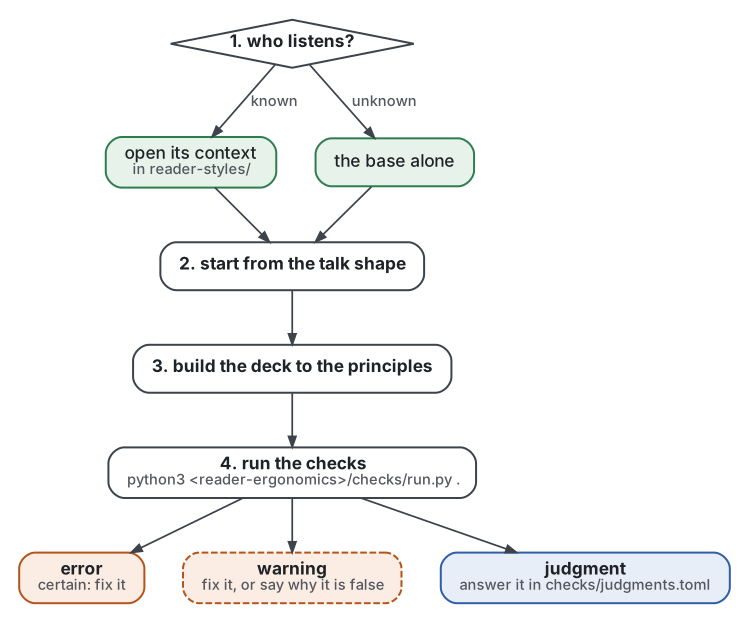
Graphviz source
// How to use the presentations standard: four steps, and what to do with each kind of finding.
digraph how_to_use {
graph [rankdir=TB, nodesep=0.4, ranksep=0.55, bgcolor="white", pad=0.2, fontname="Inter"];
node [shape=box, style="rounded,filled", fontname="Inter", fontsize=13, margin="0.2,0.1", penwidth=1.5, fontcolor="#1F2328"];
edge [fontname="Inter", fontsize=11, color="#3D434B", fontcolor="#55575F", penwidth=1.3, arrowsize=0.8];
Q [shape=diamond, style="filled", fillcolor="#FFFFFF", color="#3D434B", label=<<b>1. who listens?</b>>, margin="0.05,0.05"];
CTX [label=<open its context<br/><font point-size="11" color="#55575F">in reader-styles/</font>>, fillcolor="#E6F2EA", color="#2E7D4F"];
BASEONLY [label=<the base alone>, fillcolor="#E6F2EA", color="#2E7D4F"];
S2 [label=<<b>2. start from the talk shape</b>>, fillcolor="#FFFFFF", color="#3D434B"];
S3 [label=<<b>3. build the deck to the principles</b>>, fillcolor="#FFFFFF", color="#3D434B"];
S4 [label=<<b>4. run the checks</b><br/><font point-size="11" color="#55575F">python3 <reader-ergonomics>/checks/run.py .</font>>, fillcolor="#FFFFFF", color="#3D434B"];
E [label=<<b>error</b><br/><font point-size="11" color="#55575F">certain: fix it</font>>, fillcolor="#FBEDE4", color="#B4541A"];
W [label=<<b>warning</b><br/><font point-size="11" color="#55575F">fix it, or say why it is false</font>>, fillcolor="#FBEDE4", color="#B4541A", style="rounded,filled,dashed"];
J [label=<<b>judgment</b><br/><font point-size="11" color="#55575F">answer it in checks/judgments.toml</font>>, fillcolor="#E8EEF8", color="#2F5DA8"];
Q -> CTX [label=" known"]; Q -> BASEONLY [label=" unknown"];
CTX -> S2; BASEONLY -> S2; S2 -> S3; S3 -> S4;
S4 -> E; S4 -> W; S4 -> J;
{rank=same; E; W; J}
}- Name the audience. A context overrides the base for its room: academic audience (a conference, a seminar, a defence), business decision maker or casual audience (a meetup, a club, friends).
- Start from the talk shape, or from its example deck, example-talk.html.
- Build to the principles below, and to those of reader-ergonomics, which still hold.
- Check: the deck checks of
checks/local/run with the standard's own, on every HTML deck named inchecks/config.toml.
Grades mean what they mean in reader-ergonomics: measured, supported with caveat, convention, not supported. Each principle states its grade and never claims more.
Principles
Pace: the listener cannot reread
| Principle | Claim | Grade |
|---|---|---|
| Motion adds, never replaces | animation, video and live demos are added to an explanation, never in place of it. | supported with caveat |
| No script on screen | words on screen do not repeat the voice: show key terms and the evidence, and say the rest. | measured |
| Reveal with the voice | points appear as they are spoken, not a whole slide at once. | supported with caveat (recorded narration only) |
Slide: what the room sees
| Principle | Claim | Grade |
|---|---|---|
| Claim headline with evidence | each slide's headline is a sentence stating its claim, and the slide shows the evidence. | supported with caveat (one controlled study of a bundle) |
| Colour as a signal | colour links what belongs together and is never the only cue; data colour maps are perceptually ordered. | measured for colour coding and for colour maps |
| Legible in the room | text is readable from the back of the room: dark on light, high contrast, large type. | measured for polarity; the minimum size is a convention |
Talk: the speaker and the hour
| Principle | Claim | Grade |
|---|---|---|
| A talk is not a paper | a talk is its own genre: it says its point and plan early, returns to them, and ends on the point. | supported with caveat (descriptive genre research) |
| Gesture with the words | the speaker gestures at what is said; a visible face adds nothing consistent. | measured |
| Plan the questions | the questions are part of the talk: the likely ones are prepared, with backup slides. | convention (the research is descriptive) |
Figure: how a figure is drawn
| Principle | Claim | Grade |
|---|---|---|
| Appeal after clarity | decoration stays only when it carries the message and alters no quantity; polish comes after the other figure rules hold, and never replaces them. | supported with caveat (the meta-analyses are measured, for interfaces) |
| Drawn from source | a figure drawn as reader-ergonomics' draw relations asks is written in Graphviz: its .dot sits beside the SVG and the page that embeds it, folded under the image. Text figures stay only in files read in a terminal or by a model. |
convention, untested. The reasons are access and drift, not faster reading |
| Few crossings | in a node-link diagram, links cross as little as possible, and crossings that remain meet near a right angle. | supported with caveat (small samples; one study against) |
| Group by region | what belongs together is shown by a bounded region or a joining line, with colour as a second cue and never the only one. | supported with caveat (laboratory evidence) |
| Label in place | each node and link is labelled where it sits; a legend is used only when direct labels do not fit. | supported with caveat; for direct labels, mainly convention |
| One message | a figure has one message, and its title or caption states it. | supported with caveat |
| Position for quantities | a figure that shows a quantity shows it by position on a common scale, or by length, before angle or area. | measured, for charts |
| Text alternative | beyond the alt text of reader-ergonomics' figure next to its text, a figure of more than a few nodes has a long description of its parts and their relations. Its alt text reads each arrow in the direction the figure defines. | convention (a standard), untested with readers of documentation |
Where the evidence is
Every principle links to the review in evidence/presentations/, and every work cited is listed once in the bibliography.