Shape: figure
A figure or a diagram in any document of the family has this shape. Its parts: a caption that states the message, a drawing rendered from a source kept beside it, a text alternative, and a long description for a complex figure.
When to use it
- Wherever a page explains a relation, a set, a process or a quantity, which draw relations asks to show drawn.
- In a page read on GitHub or on a site. A file read in a terminal or by a model (AGENTS.md, llms.txt, a comment in code, a commit message) keeps a typed figure (drawn from source).
- For a diagram of relations, Graphviz (decision 0007). Inside a LaTeX document, TikZ.
Parts
| Part | What it does | Rule | Grade |
|---|---|---|---|
| Caption | states the figure's one message as a sentence | one message | supported with caveat |
| Drawing | the SVG, rendered from the source and embedded in the page | drawn from source | convention, untested |
| Alt text | says the message in one sentence, for a reader without sight | text alternative | convention (a standard) |
| Long description | lists the parts and how they relate, under the figure, when it has more than a few nodes | text alternative | convention (a standard) |
| Source | the .dot file, beside the SVG and the page that embeds it, named after that page (standard-how-to-use.dot); a model and a later editor read it |
drawn from source | convention, untested |
| Folded source | the .dot copied under the image in a <details> block titled "Graphviz source", closed until clicked, so a reader can reuse the figure from the page |
drawn from source | convention (the maintainer's rule, 2026-10-29) |
| Key | only when the notation is not obvious; labels sit on what they name | label in place | supported with caveat |
The drawing itself follows the rest of the group: reader-ergonomics' sufficient contrast, few crossings, group by region, position for quantities and appeal after clarity.
Colours
Each kind of thing gets one colour, the same in every figure of a document. Each kind is also named in its box, so colour is never the only cue. The family's figures use three kinds:
| Kind | Fill | Line | Line on white |
|---|---|---|---|
| the repository the page belongs to | #FBEDE4 |
#B4541A, heavier |
4.97:1 |
| the base standard | #E8EEF8 |
#2F5DA8 |
6.46:1 |
| another repository | #E6F2EA |
#2E7D4F |
5.05:1 |
| a link that is depended on | none | #3D434B |
9.99:1 |
| a link that may be used | none | #6A6D77, dashed |
5.16:1 |
Text is #1F2328, and a second line in a box is #55575F, both above 4.5:1 on every fill. The font is Inter.
Three things to check by eye
- An arrow drawn to a frame (a Graphviz cluster) can render as a stub with its label adrift: draw it between two nodes.
- A note that applies to several nodes is joined to each of them, not to one.
- The alt text reads each arrow in the direction the figure defines it: if
u -> vmeans "v uses u", say so.
Render
Write the .dot, then render it. The script stamps the SVG with the hash of its source, which figure-source checks. It also refreshes the folded copy under every image of the figure, and reader-ergonomics' figure-source-inline compares that copy with the file:
python3 <reader-ergonomics>/checks/figures/render_figure.py path/to/figure.dotWorked example
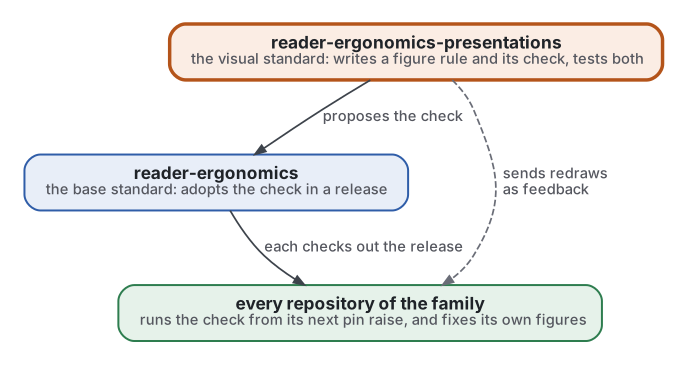
The source is example-figure.dot; each part of the shape is filled below.
A figure rule written here reaches every repository through the base standard, and the redraws reach them as feedback.
Graphviz source
// How a figure rule reaches every repository of the family: a filled example of shapes/figure.md.
// Colours: one per kind of repository, the same in every figure of the family; each kind is also named in its box.
digraph how_a_figure_rule_spreads {
  graph [rankdir=TB, nodesep=0.5, ranksep=0.6, bgcolor="white", pad=0.25, fontname="Inter"];
  node  [shape=box, style="rounded,filled", fontname="Inter", fontsize=13, margin="0.22,0.12", penwidth=1.5, fontcolor="#1F2328"];
  edge  [fontname="Inter", fontsize=11, color="#3D434B", fontcolor="#55575F", penwidth=1.3, arrowsize=0.8];

  PRES [label=<<b>reader-ergonomics-presentations</b><br/><font point-size="11" color="#55575F">the visual standard: writes a figure rule and its check, tests both</font>>,
        fillcolor="#FBEDE4", color="#B4541A", penwidth=2.6];
  RE   [label=<<b>reader-ergonomics</b><br/><font point-size="11" color="#55575F">the base standard: adopts the check in a release</font>>,
        fillcolor="#E8EEF8", color="#2F5DA8"];
  ALL  [label=<<b>every repository of the family</b><br/><font point-size="11" color="#55575F">runs the check from its next pin raise, and fixes its own figures</font>>,
        fillcolor="#E6F2EA", color="#2E7D4F"];

  PRES -> RE  [label=" proposes the check\l"];
  RE   -> ALL [label=" each checks out the release\l"];
  PRES -> ALL [style=dashed, color="#6A6D77", label="   sends redraws\l   as feedback\l"];
}- reader-ergonomics-presentations writes a figure rule and its check, and proposes the check to reader-ergonomics.
- reader-ergonomics adopts the check in a release; every repository runs it from its next pin raise and fixes its own figures.
- A dashed link goes straight from this repository to every repository: the redraws it offers as feedback.
What the checks verify
reader-ergonomics holds the program checks of figures, in its checks/figures/, so every repository of the family runs them; figure-judgment stays here, since its questions rest on this repository's figure principles.
| Check | Where | Verifies |
|---|---|---|
typed-figure |
reader-ergonomics | no figure is typed in characters outside the files listed as exempt |
figure-alt |
reader-ergonomics | no image's alt text is its file name or a word for its kind; figure-captions fails an empty one |
figure-source |
reader-ergonomics | each SVG drawn from a .dot holds the hash of that source; a stale hash fails, a missing one warns |
figure-source-inline |
reader-ergonomics | each such image has the source folded under it, equal to the file |
figure-contrast |
reader-ergonomics | each line has 3:1 against the page and its own fill, and no colour has an alpha channel |
figure-judgment |
this repository | asks, per figure, about crossings, labels, grouping, the message and decoration |