Topic


One template for a unit of writing, called a topic, whose parts can be topics of the same template. Any body of information is then written as a tree that reads the same way at every depth.
The name is the field's own. A topic is the unit of DITA and of topic-based authoring (information typing). Document models call the same unit a content object (document model), and studies of trees on screen call it a node (progressive disclosure).
This page in French: README.fr.md.
Status: one template, the topic; its check; and three multivocal reviews of 218 sources, done 2026-10-29, in evidence. No reader study has tested the template. Its gain over DITA's base topic is stated as a test with four outcomes (baseline), none of them run yet. The AI-augmented strand, on checking reasoning written as topics, left for a repository of its own the same day (0016). It is not an official standard, not a peer-reviewed study and not a new result.
How it is made: with Claude, an AI assistant by Anthropic, under the maintainer's direction, the way reader-ergonomics was made. Corrections are welcome as issues.
Take it
The topic is meant to be copied and kept as your own. Copy it from a tagged release (tags), so a later change here never changes your copy.
Copy shapes/topic.md, the shape, and checks/local/topic.py, the check, into the same paths of your repository.
Write your topics: each a file with a title and a summary, each folder's README listing its children with theirs.
Add
checks/config.toml; the last two tables are for a repository with no site stylesheet:extends = "reader-ergonomics" [topic] files = ["README.md", "docs/"] # your topics: files and folders root = "README.md" [readable_measure] stylesheets = [] [sufficient_contrast] stylesheets = []Run the standard's checks at the commit the release pins (
ref:in its checks.yml); the topic check runs beside them:git clone https://github.com/Tewf/reader-ergonomics git -C reader-ergonomics checkout <the pinned commit> python3 reader-ergonomics/checks/run.py path/to/your/repositoryHow to take your own version of the family, and where a disagreement goes: the standard's Take your own version.
Where it sits
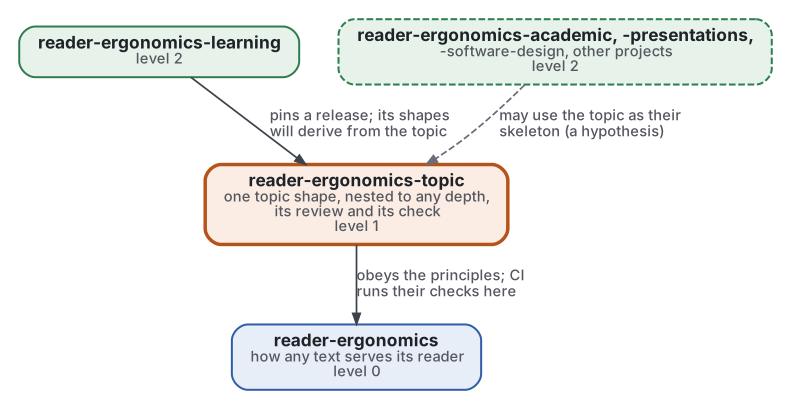
Graphviz source
digraph where_it_sits {
  graph [rankdir=TB, nodesep=0.4, ranksep=0.5, bgcolor="white", pad=0.2, fontname="Inter"];
  node  [shape=box, style="rounded,filled", fontname="Inter", fontsize=13, margin="0.2,0.1", penwidth=1.5, fontcolor="#1F2328"];
  edge  [fontname="Inter", fontsize=11, color="#3D434B", fontcolor="#55575F", penwidth=1.3, arrowsize=0.8];
  LE [label=<<b>reader-ergonomics-learning</b><br/><font point-size="11" color="#55575F">level 2</font>>, fillcolor="#E6F2EA", color="#2E7D4F"];
  OT [label=<<b>reader-ergonomics-academic, -presentations,</b><br/><font point-size="11" color="#55575F">-software-design, other projects</font><br/><font point-size="11" color="#55575F">level 2</font>>, fillcolor="#E6F2EA", color="#2E7D4F", style="rounded,filled,dashed"];
  TO [label=<<b>reader-ergonomics-topic</b><br/><font point-size="11" color="#55575F">one topic shape, nested to any depth,</font><br/><font point-size="11" color="#55575F">its review and its check</font><br/><font point-size="11" color="#55575F">level 1</font>>, fillcolor="#FBEDE4", color="#B4541A", penwidth=2.6];
  RE [label=<<b>reader-ergonomics</b><br/><font point-size="11" color="#55575F">how any text serves its reader</font><br/><font point-size="11" color="#55575F">level 0</font>>, fillcolor="#E8EEF8", color="#2F5DA8"];
  LE -> TO [label=" pins a release; its shapes\l will derive from the topic\l"];
  OT -> TO [style=dashed, color="#6A6D77", label=" may use the topic as their\l skeleton (a hypothesis)\l"];
  TO -> RE [label=" obeys the principles; CI\l runs their checks here\l"];
  {rank=same; LE; OT}
}- It obeys reader-ergonomics, so it sits one level above it, and a project that uses it sits above it in turn. No level depends on a level above it.
- reader-ergonomics never links to it: the standard links to no extension (extending.md). This repository links down to the standard, never up to the extensions.
- One extension says it will use it: reader-ergonomics-learning pins a release and states that its shapes will derive from the topic; none is written yet. That the others will use it is a hypothesis. If none does, this repository still answers one question.
Scope
| What | Why | |
|---|---|---|
| in | the evidence on recursive templates, from the reader's side | the reader is the object, as in reader-ergonomics |
| in | the topic shape: the blocks every topic has, and how a topic holds or points to other topics | one template, kept in one place |
| in | one check a program runs on a topic at any depth | what a program can check, a program checks |
| out | the genres: papers, proofs, talks, design documents | they stay in their own repositories |
| out | what a research claim is, how it is proved or verified | another problem, with its own evidence; the strand that took it up left for a sibling repository (0016) |
What the review found
Each answer links the review that holds its evidence; a grade says how strong that evidence is.
| Question | Answer | Grade | Review |
|---|---|---|---|
| Depth. Readers recall the top levels best, and reader-ergonomics caps an outline at three levels. Can the recursion be unbounded in storage and capped in what a reader sees? | Yes, as a design, under three conditions: the path to the root is shown, what most readers need sits above the first fold, and each folded topic shows a summary. Readers rarely open a second layer, and for agents a second level of folding never helped. | supported with caveat; never tested directly | progressive-disclosure |
| Self-reference. A topic type whose children are topics gives a tree; a topic that contains itself is a cycle. Which does the template need? | The recursive type only. Every document model read keeps each instance a finite tree, and forbids, reports or caps a cycle, or leaves it undefined. | convention, across 14 systems | document-model |
| Graphs. A topic used by two parents no longer forms a tree. Is the tree only the storage, and the graph the meaning? | The standards store a graph of trees and give each reading one tree: one containing parent, any other parent by reference. No study of how readers meet a reused unit was found. | convention; the reader side is a gap | document-model |
| Genres. Is the topic what the genre shapes share, or a rival to them? | What they share, as practice already does: DITA derives concept, task and reference from one base topic. Typing alone showed no learning gain in Horn's own 1969 test (19.56 against 17.65, 41 students). Whether a reader who knows the base reads a derived type better is untested. | convention; the transfer is this repository's open question | information-typing |
The baseline the topic must beat
| Reader | Baseline | Control |
|---|---|---|
| a person, the unit and its types | the DITA 1.3 base topic with its concept, task and reference types, its maps and its reuse by reference, validated, cycles reported | the same content as untyped prose |
| a person, the tree on a page | the same content as one document of at most three heading levels, its contents always visible beside it | the fully expanded tree |
| a model | passages retrieved in the document's own order, at a matched token budget | a tree of summaries |
The comparison measures finding, gist against detail, recall after a delay, transfer to a derived type never seen, and what a program check catches. Each review's baseline.md gives the design.
The topic template
| Part | Summary |
|---|---|
| shapes | the topic, the base every shape derives from, and how the four general shapes of reader-ergonomics fit it |
| the check | runs on every topic of this repository, at any depth: title, summary, listed by its parent with that summary, no inclusion cycle |
| decisions | one record per architectural choice, each opening with the decision in one sentence |
- The topic has five blocks: title, summary, body, contents and see also. Each is traced to a principle of reader-ergonomics and to the evidence here (topic).
- The four general shapes all fit, with two renames and one merge: a commit's subject line is both its title and its summary. They are the material the topic was drawn from, so the fairer test is the next line (the table).
- On six forms of the genre extensions it was not built from, five fit; a decision record with no summary does not. Run on those three repositories, 113 documents, the check finds 7 faults once their review steps are declared, in that run's configuration as types.
- The decision record, first written here, now lives in reader-ergonomics (v1.3.0). This repository's records follow it, and the check verifies that each one says so.
- This repository is its own first tree of topics: the check runs on it in CI, and the tests of the check are in checks/test_topic.py.
Next
- Compare the topic with the baseline above, on readers: the design is in each review's
baseline.md. - The genre extensions may derive their shapes from the topic; each would say so in its own repository.
Check it
git clone https://github.com/Tewf/reader-ergonomics
python3 reader-ergonomics/checks/run.py path/to/this/repository
CI runs the same checks on every push, and a run fails on any error (checks.yml). Every push to master also renders the site, tewf.github.io/reader-ergonomics-topic (pages.yml).
Licence
Code under the Apache License 2.0; prose under CC BY 4.0. Reuse it as you wish, with credit to this repository; CITATION.cff gives a citation if you need one.