Position
Each "not known" below is a statement about this search, not about the world.
Against the existing reviews
- Andersen 2015 and Batova 2014 review component content management from practice and translation; neither treats the stored tree, its recursion or its cycles.
- DeRose 2004 and Marinelli 2008 review overlap; they compare encodings, not reuse or checking.
- Murata 2005 classifies schema languages; Zhang 2012 finds weak evidence for design patterns, in code only (also reviewed in reader-ergonomics-software-design, evidence/architecture-design).
- This search did not find a review that joins a recursive content model, reuse by reference and cycle checking for documents.
- This review adds: a comparison of how 14 systems treat a cycle through a reference; corpus numbers on recursion in real documents; and 36 scored grey sources.
Known
- Document standards put recursion in the type and keep the instance a finite tree (Bray 2008; Walsh 2019; TEI 2026).
- Two standards offer a capped form beside the recursive one: five numbered levels in DocBook, seven in TEI.
- Recursion is common in schemas and rare and shallow in instances. 58% of DTDs hold recursive elements (Choi 2002, secondary); 99% of web documents have fewer than 8 levels, and 15% use recursion (Mignet 2003, secondary).
- Text has structures that one hierarchy cannot hold; every version of OHCO met a counterexample (Renear 1996).
- Where reuse is not enforced, copies are common: mean clone coverage 13.6% over 28 specifications (Juergens 2010).
- Single sourcing is adopted with costs. In 2008, half of 276 respondents used single sourcing or content management; half of the users reported significant downsides, and about 1 in 10 had seen a failure (Dayton 2010, secondary).
- Systems that allow references forbid, report or cap cycles, or leave them undefined; none read keeps a self-containing unit (state-of-the-art.md).
Not known
- Whether readers understand a reused fragment as well as one written for its place; no reader study was found.
- Whether reuse by reference keeps documentation more consistent than copies, measured over time; Juergens 2010 counts copies and estimates cost.
- How often overlap occurs in ordinary documentation, as opposed to literary and Biblical texts.
- The recall of structure and prose checkers on documentation.
- Whether a capped section (five or seven levels) or an unbounded one serves readers better: depth in view belongs to progressive-disclosure.
Where practice runs ahead of the evidence
- DITA's reuse by reference was standardised (OASIS 2010; OASIS 2015) without a published measure of its effect on consistency or readers, in this search.
- Prose linters gather thousands of stars each (state-of-the-art.md); the only effect size found for automated writing feedback is on students (Fleckenstein 2023).
- Descriptive markup was argued to lower authors' cognitive demands (Coombs 1987) and texts to be OHCOs (DeRose 1990), both without measurement.
- The single-parent rule in Notion came from permission design, not from readers (Notion 2021, the owner's account).
Where evidence is ignored by practice
- Translators report that segmented content loses context (Batova 2014), yet reuse guidance in the standards read addresses validity, not context.
- Copies are common in specifications (Juergens 2010) and inconsistent copies cause faults in code (file-structure), yet the most adopted format read, CommonMark, has no reuse mechanism in its specification (CommonMark 2024).
Self-reference: a tree or a cycle
- A template needs the recursive type, not the self-containing instance. A topic type whose children are topics gives trees of any finite depth; no model read needs a node that contains itself.
- Document models forbid the second in three ways, from strongest to weakest:
- by syntax: proper nesting makes a contained element a proper part of its container (Bray 2008, 2.1);
- by a rule on references: no recursive entity (Bray 2008, 4.1), no include within its own chain (Marsh 2006, 4.2.7);
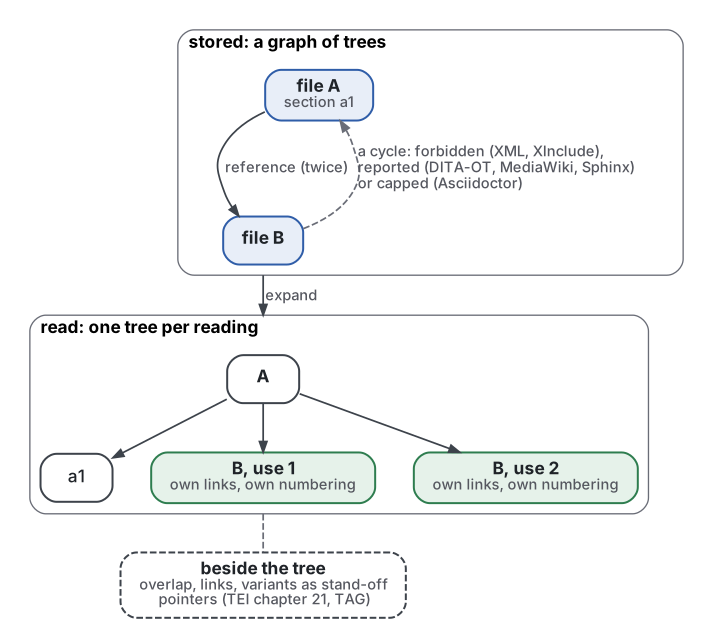
- by the processor: report the loop (DITA-OT 2026b; MediaWiki 2026b; Sphinx 2026) or cap the depth (Asciidoctor 2026; MediaWiki 2026a).
- Grade: convention, from standards; the count of systems is descriptive. No study measured readers on either side.
Graphs: is the tree only the storage, and the graph the meaning
Graphviz source
digraph document_model {
  graph [rankdir=TB, nodesep=0.4, ranksep=0.5, bgcolor="white", pad=0.2, fontname="Inter", compound=true];
  node  [shape=box, style="rounded,filled", fontname="Inter", fontsize=13, margin="0.2,0.1", penwidth=1.5, fontcolor="#1F2328"];
  edge  [fontname="Inter", fontsize=11, color="#3D434B", fontcolor="#55575F", penwidth=1.3, arrowsize=0.8];
  subgraph cluster_stored {
    label=<<b>stored: a graph of trees</b>>; labeljust=l; style="rounded"; color="#6A6D77"; fontname="Inter"; fontsize=13;
  FA [label=<<b>file A</b><br/><font point-size="11" color="#55575F">section a1</font>>, fillcolor="#E8EEF8", color="#2F5DA8"];
  FB [label=<<b>file B</b>>, fillcolor="#E8EEF8", color="#2F5DA8"];
    FA -> FB [label=" reference (twice)"];
    FB -> FA [style=dashed, color="#6A6D77", label=" a cycle: forbidden (XML, XInclude),\l reported (DITA-OT, MediaWiki, Sphinx)\l or capped (Asciidoctor)\l"];
  }
  subgraph cluster_read {
    label=<<b>read: one tree per reading</b>>; labeljust=l; style="rounded"; color="#6A6D77"; fontname="Inter"; fontsize=13;
  RA [label=<<b>A</b>>, fillcolor="#FFFFFF", color="#3D434B"];
  A1 [label=<a1>, fillcolor="#FFFFFF", color="#3D434B"];
  B1 [label=<<b>B, use 1</b><br/><font point-size="11" color="#55575F">own links, own numbering</font>>, fillcolor="#E6F2EA", color="#2E7D4F"];
  B2 [label=<<b>B, use 2</b><br/><font point-size="11" color="#55575F">own links, own numbering</font>>, fillcolor="#E6F2EA", color="#2E7D4F"];
    RA -> A1; RA -> B1; RA -> B2;
  }
  FB -> RA [ltail=cluster_stored, lhead=cluster_read, label=" expand"];
  SO [label=<<b>beside the tree</b><br/><font point-size="11" color="#55575F">overlap, links, variants as stand-off</font><br/><font point-size="11" color="#55575F">pointers (TEI chapter 21, TAG)</font>>, fillcolor="#FFFFFF", color="#3D434B", style="rounded,filled,dashed"];
  B1 -> SO [ltail=cluster_read, style=dashed, color="#6A6D77", arrowhead=none];
}- The standards read invert the question. What is stored is a graph of trees: files that include or reference other files, each a tree. What one reading gets is a tree: the references expanded for that place.
- A unit used by two parents is allowed only as a reference, never as a node nested twice (Marsh 2006; OASIS 2015; MediaWiki 2026a).
- Whatever depends on position then needs a rule per use. DITA's
@copy-togives each use its own links and navigation (OASIS 2015); Sphinx picks one parent (Sphinx 2026); Notion keeps one parent for permissions (Notion 2021). - Meaning that crosses the hierarchy is a graph held beside the tree: overlap, links and variants as stand-off pointers or a hypergraph (Renear 1996; TEI 2026, chapter 21; Haentjens Dekker 2017).
- DITA keeps the links between topics in maps rather than in the topics, to keep each topic reusable, and allows nested topics only with special care (OASIS 2015, 2.2.1.6).
- Graphs of summaries for a model as reader (Edge 2024) are reviewed in progressive-disclosure; here they bear only on storage.
- So the evidence allows: one containment tree per reading, a reference graph that must stay acyclic, and cross-links held apart. It does not show that either view helps human readers.
What this repository adds
Candidate rules for the topic, each a hypothesis graded convention, untested:
- A topic's children are topics; an instance never contains itself.
- A topic has one containing parent; every other use is a reference, resolved into a tree when read.
- The reference graph is acyclic; a check reports a cycle, with a depth cap as a backstop.
- A reused topic must be valid in each place it is used (the DITA rule, OASIS 2015), and carries what its reader needs without its first context.
- Relations that cross the tree (overlap, links) are pointers beside the tree, not nesting.
- It does not claim a new result or the state of the art.