Sources: the pool, the flow and the scores
This file is the information-typing pool: the flow from hits to sources, then each source with its quality. Searches: protocol.
Flow
| Stage | Formal | Grey |
|---|---|---|
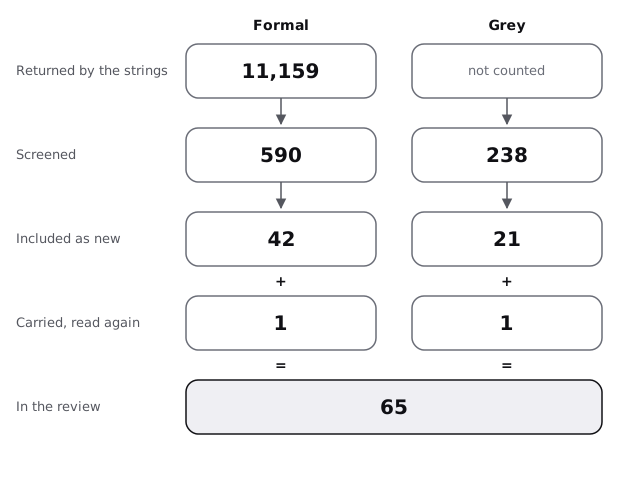
| Returned by the strings | 11,159 | not recorded |
| Screened | 590 | 238 |
| Included as new | 42 | 21 |
| Carried, read again | 1 | 1 |
| In the review | 43 | 22 |
Formal:
- 11,159 records were returned (Semantic Scholar 10,979 over 31 strings; arXiv 180 over 9 strings).
- 590 were screened by title, with repeats across strings.
- 42 were included as new; Kintsch 1978 was carried from reader-ergonomics and read again first-hand.
- About 548 were excluded, for the reasons below.
Grey:
- The web strings returned about 47 results and the producer visits 12; the Q/A strings 179 records. No total is recorded for the web.
- 238 were screened (59 web, 179 Q/A).
- 21 were included as new (9 web, 12 Q/A threads); Horn 1969 was carried and read first-hand for the first time.
In the review: 65 sources, 43 formal and 22 grey. DITA-OT 2026 is the reviewer's own count of a public repository, not a source, and is not scored.
Formal exclusions, counted by title and rounded to tens:
- repeats across strings: 60;
- another field using the same words (genetics, physics, image annotation, topic models, crisis tweets): 330;
- school writing and second-language teaching with no reading or typing claim: 90;
- reuse, single-sourcing and content management without types (document-model): 30;
- relevant but not reached or not opened, located only: 10 (Clark 2016, Harrison 2005, Horn 1992, Schmitz 2017, Dixon 2009, Yayli 2011, Mustafa 1995). Also: the Berkenkotter and Huckin book, a 2013 review of the Sydney School book.
The categories above account for 520 of the 548 formal exclusions; 28 were excluded without a recorded reason.
Grey exclusions, rounded:
- known sources seen again: 10;
- not about typed units: 25;
- pages found but not read (one vendor page timed out; drafts of DITA 2.0): 5;
- Q/A records not included after reading the title or the thread: 167, repeats across the 14 strings included.
Added by snowballing: Mandler 1977, Rumelhart 1975 and Stein 1975 were reached again from Kintsch 1978; Bogaerds-Hazenberg 2023 from Bogaerds-Hazenberg 2020.
Existing reviews found: 8; 7 are in review.md strand 0, and Clark 2016 was located only.
The figure draws the stages of the table for information typing.
Formal sources
Grade vocabulary as in the README. "lead" means named in the commissioning brief and verified here; "carried" means the key comes from another repository's bibliography.
| Key | Kind | Found via | Quality | Used in |
|---|---|---|---|---|
| Kintsch 1978 | formal | carried (reader-ergonomics) | theory; two sections read first-hand | frame; review 1; state-of-the-art; position |
| Rumelhart 1975 | formal | F8 | theory, title and venue only | frame; review 1 |
| Mandler 1977 | formal | lead; F8 | measured, children and adults, ERIC abstract | frame; review 1 |
| Thorndyke 1977 | formal | lead | measured, two experiments, ERIC abstract | frame; review 1 |
| Stein 1975 | formal (research report) | lead | measured, 48 children, ERIC abstract (secondary) | frame; review 1 |
| Mandler 1978 | formal | F8; F31 | title and venue only | review 1 |
| Black 1979 | formal | lead; F8 | critique, abstract | review 1, 6; state-of-the-art; against |
| Trabasso 1985 | formal | F8 | title and venue only | frame; review 1; against |
| Kintsch 1982 | formal | F28 | measured, ERIC and APA abstracts | review 4; state-of-the-art; baseline |
| Meyer 2001 | formal | lead | measured, adults, three groups, ERIC abstract | frame; review 5 |
| Hebert 2016 | formal | F10 | meta-analysis, 45 studies, ERIC abstract (secondary) | review 0, 5; baseline |
| Pyle 2017 | formal | F10 | meta-analysis, 19 studies, abstract (secondary) | review 0; against |
| Bogaerds-Hazenberg 2020 | formal | F10 | meta-analysis, 44 studies, abstract (secondary) | review 0; against; baseline |
| Eiriksdottir 2011 | formal | F27 | narrative review, PubMed abstract | frame; review 0, 5; position |
| Andersen 2015 | formal | F18; F29 | integrative review, title and venue only here; read in document-model | frame; review 0 |
| Batova 2014 | formal | F18 | integrative review, title and venue only here; read in document-model | review 0 |
| Batova 2017 | formal | F18 | systematic review, title and venue only here; read in document-model | review 0 |
| Zwaan 1994 | formal | F26 | measured, two experiments, abstract (secondary) | frame; review 4; against |
| Triantafyllopoulos 2021 | formal | F26 | measured, three online experiments, abstract | review 4; against |
| Markevich 2025 | formal | F26 | measured, descriptive, 44 adolescents, abstract | review 4 |
| Horn 1981 | formal | F7 | title and venue only | frame; review 2 |
| Horn 1999 | formal | F3; F7 | title and venue only | review 2 |
| Fields 1981 | formal | F4 | survey, ERIC abstract | review 2 |
| Fields 1982 | formal | F3 | evaluation, title and venue only | review 2 |
| Hartley 1981 | formal | F4 | critique, abstract | review 2 |
| Jonassen 1980 | formal | F4 | measured, one comparison; journal abstract (secondary), the ERIC abstract gave no result | review 2; state-of-the-art |
| Kools 2008 | formal | F4 | measured, one text varied, abstract | review 2, 4; against; baseline |
| Priestley 2001 | formal | F2 | architecture paper, title and venue only here; read in document-model | review 3 |
| Priestley 2002 | formal | F2 | architecture paper, title and venue only | review 3 |
| Evia 2015 | formal | F2; F18 | teaching account, title and venue only | review 3 |
| Swarts 2022 | formal | F30 | measured, descriptive, corpus, abstract | review 3 |
| Heinonen 2022 | formal | F29 | exploratory user studies, three countries, abstract | review 3 |
| Bailie 2015 | formal | F2 | two case studies, title and venue only | review 6 |
| Coggio 2015 | formal | F18 | case study, title and venue only | review 6 |
| Batova 2018 | formal | F18 | qualitative, 12 months, one company, abstract | review 6; state-of-the-art; against |
| Carroll 1987 | formal | F16 | title and venue only | frame; review 4; against |
| Lazonder 1993 | formal | F17 | title and venue only | review 4; against |
| Miller 1984 | formal | F13 | theory, title and venue only | frame |
| Cheng 2007 | formal | F15 | title and venue only | frame; review 5 |
| Artemeva 2008 | formal | F14 | title and venue only | frame; review 5 |
| Brent 2011 | formal | F14 | title and venue only | frame; review 5 |
| Jimeno Yepes 2024 | formal | X1 | measured, preprint, abstract | review 7; state-of-the-art; position; baseline |
| Mortezaagha 2026 | formal | X2 | measured, preprint, 2,359 articles, abstract (secondary) | review 7; against |
Grey sources, scored
Subtotals as in the evidence README.
| Key | Kind | Found via | Quality (total, then subtotals) | Used in |
|---|---|---|---|---|
| Horn 1969 | grey tier 1 (government report) | carried; G1 | 18.5 of 20 (4 / 6 / 2.5 / 1 / 1 / 2 / 1 / 1); the encyclopedia page once cited under this key scored 6.5 | review 2, 4; state-of-the-art; position; against; baseline |
| OASIS 2015 | grey tier 1 (standard) | P | 16.5 of 20 (4 / 4.5 / 2.5 / 1 / 1 / 1.5 / 1 / 1) | frame; review 3, 8; state-of-the-art; position; against; baseline |
| Bogaerds-Hazenberg 2023 | grey tier 1 (doctoral thesis) | snowball | 18.5 of 20 (4 / 6 / 3.5 / 1 / 1 / 1.5 / 0.5 / 1) | review 0, 5 |
| Baker 2013 | grey tier 1 (book; publisher page only) | lead; P | 10 of 20 (3.5 / 2 / 1 / 1 / 0 / 1 / 0.5 / 1); scored low for being unread | frame; review 8 |
| Baker 2018b | grey tier 1 (book; publisher page only) | lead; P | 9.5 of 20 (3.5 / 2 / 1 / 1 / 0 / 1 / 0 / 1) | frame (example only); against |
| SchemaOrg 2026 | grey tier 2 (vocabulary pages) | P | 14 of 20 (4 / 3 / 3.5 / 1 / 0.5 / 0.5 / 1 / 0.5) | frame; review 8; state-of-the-art; position |
| Kubernetes 2026b | grey tier 2 (project documentation) | P | 12 of 20 (2.5 / 3 / 3.5 / 1 / 0 / 0.5 / 1 / 0.5) | frame; review 8; state-of-the-art; position; baseline |
| Information Mapping 2026 | grey tier 2 (company page) | P | 5 of 20 (2 / 1 / 0.5 / 0 / 0 / 0.5 / 0.5 / 0.5) | frame; review 8; position; against (example only) |
| DITAWriter 2026 | grey tier 3 (informal list) | P | 13.5 of 20 (3 / 4 / 3.5 / 1 / 0.5 / 1 / 0.5 / 0) | protocol; review 8; state-of-the-art; position; baseline |
| Johnson 2013 | grey tier 3 (blog) | G3 | 13 of 20 (2 / 4.5 / 3 / 1 / 1 / 1 / 0.5 / 0) | against |
| WSE 2018a | grey tier 2 (Q/A) | TU1 | 13 of 20 (2 / 4 / 2.5 / 1 / 1 / 1.5 / 0.5 / 0.5) | frame; against |
| WSE 2018b | grey tier 2 (Q/A) | TU1 | 13 of 20 (1.5 / 4 / 3.5 / 1 / 1 / 1.5 / 0 / 0.5) | frame; review 8; against |
| WSE 2014a | grey tier 2 (Q/A) | TU1 | 11 of 20 (2 / 3 / 3.5 / 1 / 0 / 1 / 0 / 0.5) | review 8; state-of-the-art; against |
| WSE 2018c | grey tier 2 (Q/A) | TU14 | 12.5 of 20 (2 / 4 / 2.5 / 1 / 0.5 / 1.5 / 0.5 / 0.5) | review 8 |
| WSE 2018d | grey tier 2 (Q/A) | TU8 | 11 of 20 (1.5 / 3 / 3.5 / 1 / 0 / 1 / 0.5 / 0.5) | review 8 |
| WSE 2014b | grey tier 2 (Q/A) | TU8 | 10 of 20 (0.5 / 4 / 3 / 1 / 0 / 1 / 0 / 0.5) | review 8 |
| WSE 2020a | grey tier 2 (Q/A) | TU12 | 8.5 of 20 (1 / 2 / 3 / 1 / 0 / 1 / 0 / 0.5) | frame; review 8; position; against (example only) |
| WSE 2022a | grey tier 2 (Q/A) | TU12 | 11 of 20 (0.5 / 4.5 / 3 / 1 / 0.5 / 1 / 0 / 0.5) | frame; review 8 |
| SO 2013a | grey tier 2 (Q/A) | TU11 | 12.5 of 20 (1.5 / 4 / 3.5 / 1 / 0.5 / 1.5 / 0 / 0.5) | review 8; against |
| SO 2016b | grey tier 2 (Q/A) | TU2 | 13.5 of 20 (1.5 / 4.5 / 4 / 1 / 0.5 / 1.5 / 0 / 0.5) | review 8 |
| SO 2019a | grey tier 2 (Q/A) | TU11 | 8 of 20 (0.5 / 3 / 2.5 / 1 / 0 / 0.5 / 0 / 0.5) | review 8 (example only) |
| UXSE 2014a | grey tier 2 (Q/A) | TU13 | 11.5 of 20 (1 / 3 / 4 / 1 / 0.5 / 1 / 0.5 / 0.5) | review 8 |
Result of the scoring
- 22 grey sources scored: 10 from the web and 12 Q/A threads. 4 fall below 10 of 20: Information Mapping 2026, Baker 2018b, WSE 2020a and SO 2019a. They appear only as examples of practice.
- Baker 2013 and WSE 2014b sit at exactly 10 and stay in; Baker 2013 is used only for what its publisher lists.
- The highest scores go to the 1969 report itself (Horn 1969), a doctoral thesis (Bogaerds-Hazenberg 2023) and the DITA standard (OASIS 2015).
- Horn 1969 rose from 6.5 to 18.5 because the report, not an encyclopedia page about it, was read; the change was sent to the repositories that cite Horn 1969.
- Linked, not reviewed again: Meyer 1975 (top-level structure, reviewed in psycholinguistics); Red Hat 2026b and GitLab 2026 (topic types and modules, reviewed in documentation).