Sources: the pool, the flow and the scores
This file is the progressive-disclosure pool: the flow from hits to sources, then each source with its quality. Searches: protocol; terms in frame.
Flow
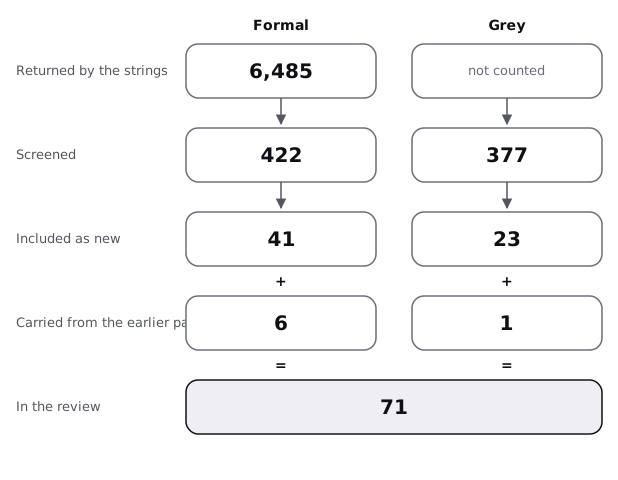
| Stage | Formal | Grey |
|---|---|---|
| Returned by the strings | 6,485 | not recorded (Q/A 318) |
| Screened | 422 | 377 |
| Included as new | 41 | 23 |
| Carried from linked reviews | 6 | 1 |
| In the review | 47 | 24 |
- Formal:
- 6,485 records were returned: Semantic Scholar 6,374 and arXiv 111. The two unusable "outliner" counts (F13) are left out.
- 422 were screened by title (382 Semantic Scholar, 40 arXiv), with repeats across strings. The protocol's rule, the 15 most cited per string, would give 392 on Semantic Scholar; the 10 not screened are not recorded.
- 41 were included as new: 23 from the strings, 11 from leads named in the brief and checked, 4 by backward snowballing, 3 by handoff from information-typing.
- Excluded, by title, rounded to tens: repeats across strings 40; off topic (medicine, physics, images, maps, biology) 260.
- Also excluded: systems or techniques with no reader study 60; model pipelines not about reading a document tree 40.
- Grey:
- The web strings showed 45 links and the producer visits 14 pages; the Q/A strings returned 318 threads. Engine totals were not recorded.
- 377 were screened (27 for G1, 18 for G2, 14 visits, 318 threads).
- 23 were included as new: 8 from the web and 12 threads, scored here; 3 by handoff from information-typing (one blog, two threads). Two public counts (GitHub 2026c, Obsidian 2026) are the reviewer's measurements and are not scored.
- Excluded: Q/A threads not included after the title or the thread, 306; tickets, fan and catalogue pages, 41.
- Also excluded: pages with no data or unreachable (two Web Almanac chapters, two 404 pages, one paywalled guideline), 5.
- Existing reviews found: 7, placed in review.md strand 0.
The figure draws the stages of the table for progressive disclosure.
Formal sources
"lead" means named in the brief or recalled, then verified against Crossref or arXiv before use.
| Key | Kind | Found via | Quality | Used in |
|---|---|---|---|---|
| Cockburn 2009 | formal | F6, F8; lead | review, read in full | review 0, 4; state-of-the-art; position; against; baseline |
| Chen 1996 | formal | lead | meta-analysis of 23 experiments, abstract (secondary) | review 0, 3; state-of-the-art; against |
| Dillon 1998 | formal | R1 | review, abstract | review 0; against |
| Brusilovsky 2001 | formal | R1, R2 | survey, relevant sections read | review 0; frame; against |
| Knutov 2009 | formal | R2 | survey, title only | review 0 |
| Lam 2011 | formal | R3 | synthesis of studies, title only | review 0 |
| DeStefano 2007 | formal, carried | held by learning-science | review of 38 studies | review 0, 3 |
| Furnas 1986 | formal | F7; lead | measured, one experiment of 20 subjects, full text | frame; review 1, 2, 5; state-of-the-art; position; against |
| Engelbart 1968 | formal | snowball, Furnas 1986 | title and venue only | review 1 |
| Bederson 1994 | formal | lead | system, title only | frame; review 1 |
| Robertson 1993 | formal | F7, F10 | system, title and Cockburn 2009 | review 1 |
| Carroll 1984 | formal | lead | measured, abstract | frame; review 1 |
| Egan 1989 | formal | lead; snowball, Chimera 1994 | measured, abstract (secondary) | review 2; state-of-the-art |
| Chimera 1994 | formal | F16 | measured, 41 novices, technical report version read | frame; review 2, 5; state-of-the-art; position; against; baseline |
| Hornbæk 2003 | formal | F10 | measured, full text | review 2; state-of-the-art; position; against; baseline |
| Höök 1997 | formal | F1, F20 | descriptive, full text (9 subjects, no statistical test) | review 2 |
| McDonald 2009 | formal | F21 | measured, 749 Internet users, authors' version read | frame; review 2; state-of-the-art; position; against; baseline |
| Springer 2020 | formal | F4 | measured, four studies, abstract | review 2 |
| Zellweger 2000 | formal | lead | located only | review 2 |
| Boyle 1994 | formal | lead | located only | review 2 |
| Mohageg 1992 | formal | lead | measured, full text | frame; review 3; state-of-the-art; position; against |
| McDonald 1998 | formal | lead | measured, full text | frame; review 3; position; against; baseline |
| McDonald 1996 | formal | F11, F12 | located only | review 3 |
| Calisir 2003 | formal | F11 | located only | review 3 |
| Potelle 2003 | formal | lead | located only | review 3 |
| Amadieu 2009 | formal, carried | held by learning-science and reading-order | measured, one study | review 3 |
| Hornbæk 2002 | formal | F9 | measured, 32 subjects, abstract | frame; review 4; state-of-the-art; against; baseline |
| Jakobsen 2006 | formal | F24 | measured, through Cockburn 2009 (secondary) | review 4; state-of-the-art |
| Nekrasovski 2006 | formal | snowball, Cockburn 2009 | measured, through Cockburn 2009 (secondary) | review 4; against |
| Plaisant 2002 | formal | snowball, Cockburn 2009 | measured, through Cockburn 2009 (secondary) | review 4 |
| Baudisch 2002 | formal | F6, F8 | measured, through Cockburn 2009 (secondary) | review 4 |
| Kiger 1984 | formal, carried | held by file-structure | measured, menus | review 5 |
| Larson 1998 | formal, carried | held by file-structure | measured, web sites | review 5 |
| Conklin 1987 | formal, carried | held by typography-and-layout | survey | frame |
| Wu 2021 | formal | F17, A1 | abstract (secondary); its scores read in Sarthi 2024 | frame; review 6 |
| Sarthi 2024 | formal | F18, A3; lead | measured on benchmarks, full text | frame; review 6; state-of-the-art; against; baseline |
| Chen 2023 | formal | lead | measured on benchmarks, abstract | review 6 |
| Chang 2024 | formal | lead | measured, 100 books, abstract (secondary) | review 6; against |
| Edge 2024 | formal | snowball, He 2026 | measured on one corpus class, abstract | review 6 |
| Laitenberger 2025 | formal | A3 | measured on three benchmarks, EMNLP (2025), full text | review 6; state-of-the-art; position; against; baseline |
| Jayraj 2026 | formal | F18, A3 | measured, preprint, abstract (secondary) | review 6; against |
| He 2026 | formal | F5 | measured on ∞Bench, preprint, full text | frame; review 5, 6; state-of-the-art; position; against; baseline |
| Otter 2000 | formal | F12 | title only | baseline |
| Heinonen 2022 | formal | handoff, information-typing | exploratory user studies, three countries, abstract (secondary) | review 2 |
| Swarts 2022 | formal | handoff, information-typing | measured, descriptive, corpus, abstract | review 5 |
| Mortezaagha 2026 | formal | handoff, information-typing | measured, 2,359 articles, preprint, abstract (secondary) | review 6 |
| Garousi 2019 | formal, carried | method | guidelines | protocol |
Grey sources, scored
Subtotals as in the evidence README.
| Key | Kind | Found via | Quality (total, then subtotals) | Used in |
|---|---|---|---|---|
| Nielsen 2006b | grey tier 2 | P | 12.5 of 20 (4 / 3.5 / 1 / 1 / 0.5 / 1 / 1 / 0.5) | frame; review 1, 5, 7; state-of-the-art; position; against |
| GOV.UK 2026a | grey tier 1 | P | 17 of 20 (4 / 5 / 3.5 / 1 / 0.5 / 1 / 1 / 1) | review 7; state-of-the-art; position |
| GOV.UK 2026b | grey tier 1 | P | 16 of 20 (4 / 4.5 / 3.5 / 1 / 0.5 / 0.5 / 1 / 1) | review 7; state-of-the-art; position |
| W3C 2026b | grey tier 1 | P | 14.5 of 20 (4 / 4 / 3.5 / 0 / 0.5 / 0.5 / 1 / 1) | review 7 |
| WHATWG 2026 | grey tier 1 | P | 15.5 of 20 (4 / 4 / 3.5 / 1 / 0.5 / 0.5 / 1 / 1) | frame; review 7; state-of-the-art; position |
| Wikimedia 2016 | grey tier 2 | G1 | 17 of 20 (3.5 / 5.5 / 3.5 / 1 / 0.5 / 2 / 0.5 / 0.5) | review 7; state-of-the-art; position; against; baseline |
| Wikipedia 2026c | grey tier 2 | G2 | 11 of 20 (0.5 / 3.5 / 3.5 / 1 / 1 / 0.5 / 0.5 / 0.5) | frame; review 1 |
| VectifyAI 2026 | grey tier 2 | P | 9 of 20 (2 / 3.5 / 0.5 / 0.5 / 0.5 / 0.5 / 1 / 0.5) | review 7; state-of-the-art; against (example only) |
| Wang 2023 | grey tier 2, carried | held by typography-and-layout | 9 of 20 there | review 7; against (example only) |
| UXSE 2010 | grey tier 2 | RD2 | 14 of 20 (2 / 4.5 / 3.5 / 1 / 0 / 1.5 / 1 / 0.5) | review 7 |
| UXSE 2012a | grey tier 2 | RD1 | 14.5 of 20 (1.5 / 5 / 3.5 / 1 / 0.5 / 1.5 / 1 / 0.5) | review 7 |
| UXSE 2012b | grey tier 2 | RD15 | 12 of 20 (1.5 / 4 / 3 / 1 / 0.5 / 1 / 0.5 / 0.5) | review 7; against |
| UXSE 2014b | grey tier 2 | RD6 | 10 of 20 (1 / 3 / 3 / 1 / 0 / 1 / 0.5 / 0.5) | review 7; position |
| UXSE 2015 | grey tier 2 | RD14 | 11 of 20 (1 / 4 / 3 / 1 / 0 / 1.5 / 0 / 0.5) | review 7 |
| UXSE 2016 | grey tier 2 | RD16 | 8 of 20 (0.5 / 2.5 / 2.5 / 1 / 0 / 0.5 / 0.5 / 0.5) | review 7 (example only) |
| UXSE 2018a | grey tier 2 | RD5 | 9.5 of 20 (0.5 / 3.5 / 3 / 1 / 0 / 1 / 0 / 0.5) | review 7 (example only) |
| WSE 2013 | grey tier 2 | RD9 | 11 of 20 (0.5 / 4 / 3.5 / 1 / 0.5 / 1 / 0 / 0.5) | review 7; baseline |
| WSE 2018e | grey tier 2 | RD9 | 13 of 20 (2 / 4.5 / 3.5 / 1 / 0.5 / 1 / 0 / 0.5) | review 7 |
| SESE 2011o | grey tier 2 | RD11 | 15 of 20 (2.5 / 4.5 / 3.5 / 1 / 0.5 / 1.5 / 1 / 0.5) | review 7; against |
| SESE 2011r | grey tier 2 | RD12 | 13 of 20 (0.5 / 4.5 / 3.5 / 1 / 0.5 / 1.5 / 1 / 0.5) | review 7 |
| SESE 2014e | grey tier 2 | RD12 | 14 of 20 (2 / 4.5 / 3.5 / 1 / 0.5 / 1.5 / 0.5 / 0.5) | review 7; position; against |
| Johnson 2013 | grey tier 3 | handoff, information-typing | 13 of 20 there (2 / 4.5 / 3 / 1 / 1 / 1 / 0.5 / 0) | review 2 |
| WSE 2018c | grey tier 2 | handoff, information-typing | 12.5 of 20 there (2 / 4 / 2.5 / 1 / 0.5 / 1.5 / 0.5 / 0.5) | review 7 |
| UXSE 2018b | grey tier 2 | handoff, information-typing | 8.5 of 20 (0.5 / 3 / 2.5 / 1 / 0.5 / 0.5 / 0 / 0.5) | review 7 (example only) |
Counts, not scored: GitHub 2026c (stars and topic counts) and Obsidian 2026 (plugin downloads), both read on 2026-10-29, used in state-of-the-art.md.
Result of the scoring
- 21 grey sources scored here: 8 from the web, 13 Q/A threads; 2 more keep their information-typing scores. 4 fall below 10: VectifyAI 2026, UXSE 2016, UXSE 2018a, UXSE 2018b. With the carried Wang 2023, 5 are examples only.
- UXSE 2014b sits exactly at 10 and stays in.
- The highest scores go to a government design system (GOV.UK 2026a) and a research wiki page with data (Wikimedia 2016).
- A Q/A thread scores 0.5 on authority for the site, plus 1 for a top answerer at or above 20,000 reputation, or 0.5 at or above 5,000.
- Impact is 1 at 20,000 views or 30 votes, 0.5 at 3,000 views or 10 votes.
- Reputation, votes and views are those of 2026-10-29.