The software design standard
What designing software before the code shares, as far as the evidence goes: the rules for an algorithm's specification, a design document, a decision record, an architecture description and a diagram. It extends reader-ergonomics, the standard for any reader: read that one first. This page adds only what software design changes, since its reader is often an implementer, a person or a model, who builds from the text.
How to use it
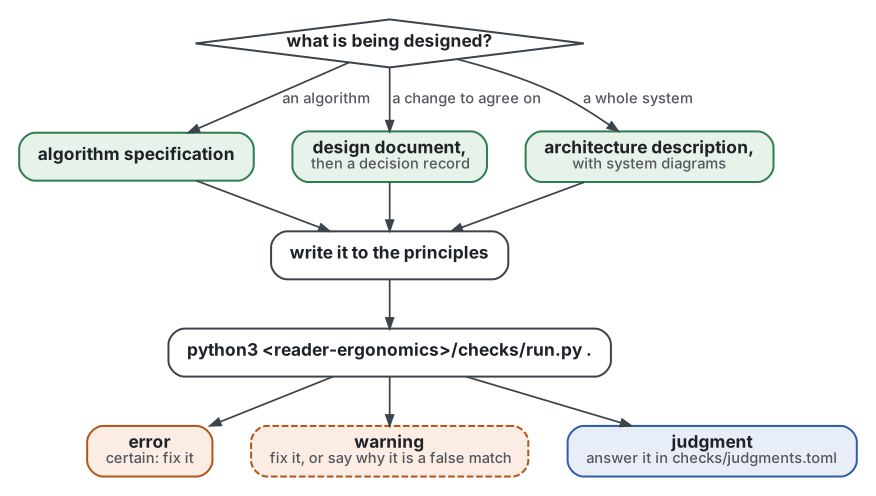
Graphviz source
digraph how_to_use {
graph [rankdir=TB, nodesep=0.4, ranksep=0.5, bgcolor="white", pad=0.2, fontname="Inter"];
node [shape=box, style="rounded,filled", fontname="Inter", fontsize=13, margin="0.2,0.1", penwidth=1.5, fontcolor="#1F2328"];
edge [fontname="Inter", fontsize=11, color="#3D434B", fontcolor="#55575F", penwidth=1.3, arrowsize=0.8];
Q [label=<<b>what is being designed?</b>>, fillcolor="#FFFFFF", color="#3D434B", shape=diamond, style="filled", margin="0.05,0.05"];
AL [label=<<b>algorithm specification</b>>, fillcolor="#E6F2EA", color="#2E7D4F"];
DD [label=<<b>design document,</b><br/><font point-size="11" color="#55575F">then a decision record</font>>, fillcolor="#E6F2EA", color="#2E7D4F"];
AD [label=<<b>architecture description,</b><br/><font point-size="11" color="#55575F">with system diagrams</font>>, fillcolor="#E6F2EA", color="#2E7D4F"];
PR [label=<<b>write it to the principles</b>>, fillcolor="#FFFFFF", color="#3D434B"];
RUN [label=<<b>python3 <reader-ergonomics>/checks/run.py .</b>>, fillcolor="#FFFFFF", color="#3D434B"];
Q -> AL [label=" an algorithm"];
Q -> DD [label=" a change to agree on"];
Q -> AD [label=" a whole system"];
{rank=same; AL; DD; AD}
AL -> PR;
DD -> PR;
AD -> PR;
PR -> RUN;
E [label=<<b>error</b><br/><font point-size="11" color="#55575F">certain: fix it</font>>, fillcolor="#FBEDE4", color="#B4541A"];
W [label=<<b>warning</b><br/><font point-size="11" color="#55575F">fix it, or say why it is a false match</font>>, fillcolor="#FBEDE4", color="#B4541A", style="rounded,filled,dashed"];
J [label=<<b>judgment</b><br/><font point-size="11" color="#55575F">answer it in checks/judgments.toml</font>>, fillcolor="#E8EEF8", color="#2F5DA8"];
RUN -> E;
RUN -> W;
RUN -> J;
{rank=same; E; W; J}
}- Pick the shape from shapes/, and name it in the document with a
**Shape:**line that links it; the checks find their documents by that line. - Write to the principles below, and to those of reader-ergonomics, which still hold.
- Check: copy
checks/local/into your repository and run the standard's checks.algorithm-specsanddesign-docsfind each document by its Shape line and check it against its shape;diagram-keyschecks every Mermaid diagram;decision-records, in the standard, checks the records.
Grades mean what they mean in reader-ergonomics: measured, supported with caveat, convention, not supported. Each principle states its grade and never claims more.
Principles
Specification: before the code is written
| Principle | Claim | Grade |
|---|---|---|
| Code-like steps | an algorithm's steps are written as constrained, code-like pseudocode, one statement per line, not as prose. | measured, in old and small experiments |
| Contract before steps | an algorithm's specification states its contract before its steps: the precondition the caller ensures, and the postcondition the code ensures. | convention, untested for the order; measured, observational and small for contracts in code |
| Examples and properties as tests | a specification handed to an implementer, a person or a model, carries examples with their expected outputs, edge cases first, and properties that hold for every valid input. | measured, on model benchmarks; convention, untested for people |
Decision: proposing a design and keeping the choice
| Principle | Claim | Grade |
|---|---|---|
| The decision asked comes first | a design document opens with the decision it asks of the reviewer, before the motivation. | convention, untested (a hypothesis to test) |
| Design the failure paths | a design names how each part fails and how each failure is handled, and its plan tests those paths. | measured, descriptive (failure studies), for where failures come from; convention, untested for the document that names them |
| Keep the options that lost | a decision record lists every option considered, the chosen one included, with its consequences and why the others lost. | convention, adopted; one writer-side experiment |
Structure: describing and drawing a system
| Principle | Claim | Grade |
|---|---|---|
| Order a description by the reader's questions | an architecture description follows its readers' questions, in order: its readers, the system's surroundings, its parts, its invariants, its runtime and deployment, and its reasons. | convention, untested; the one controlled experiment found no effect of the structure |
| Every diagram has a key, every arrow a label | every diagram of a system has a key, and every arrow says what it carries, in the direction it points. | convention, untested |
Where the evidence is
Every principle links its review in evidence/, and every work cited is listed once in the bibliography.