Sources: the pool, the flow and the scores
This file shows how the pool of the design-decisions review narrowed. It then gives one row for every source in the review: kind, route of discovery, quality score and the places that use it. The method and the strings of the review are in protocol. The architecture terms it uses (viewpoint, architectural knowledge) are defined in architecture-descriptions.
Flow
| Stage | Formal | Grey |
|---|---|---|
| Returned by the strings | 2,267 | not recorded |
| Screened | 231 | 400 |
| Included as new | 15 | 27 |
| Carried from the earlier pass | 33 | 19 |
| In the review | 48 | 46 |
- Formal:
- 2,267 records were returned (Semantic Scholar 2,092; arXiv 175).
- 231 were screened by title, with repeats across strings.
- 15 were included as new, plus 1 thesis counted as grey.
- About 14 were already in the narrative review, among the 33 formal sources it carried.
- About 200 were excluded, for the reasons below.
- Grey:
- The web search returned about 75 results, the producer visits 5 and the Q/A strings 320 records, with repeats across strings; no total is recorded.
- 400 were screened (80 web, 320 Q/A).
- 26 were included as new (11 web, 15 Q/A threads), 27 with the thesis found by the formal strings.
- 19 were already in the narrative review.
- About 374 were excluded, for the reasons below.
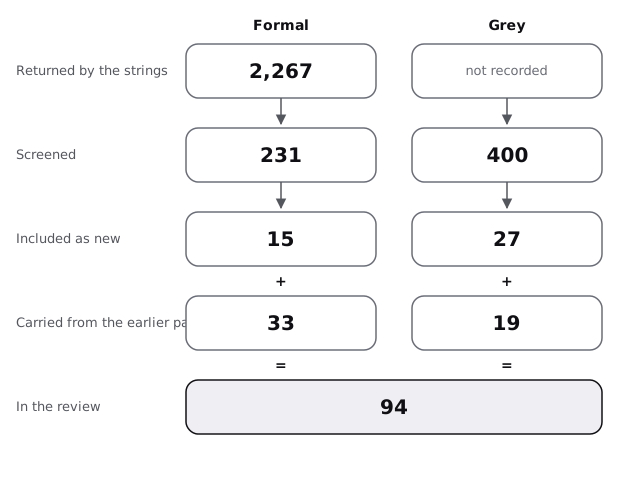
In the review: the design decisions source rows of each kind, counted by script.
The figure draws the stages of the table for design decisions.
- Formal exclusions, counted by title and rounded to tens:
- repeats across strings: 40;
- not about software documents (physics, imaging, buildings, networks): 85;
- LLM generators, mining tools and notation proposals with no bearing on document form: 70;
- relevant but not read, located only: 6.
- Two IEEE Software articles by Keeling (2022), a 2018 MADR workshop paper, a 2019 generalised MADR paper.
- An ADR explainability framework and a 2023 agile ADR study.
- Grey exclusions, rounded:
- known sources seen again: 12;
- not software design: 12;
- vendors of documentation products: 8;
- project ADR pages that are examples of use, not accounts: 20;
- pages found but not read: 15;
- books not read: 2;
- Q/A records not included after reading the title or the thread: 305 (repeats across the 18 strings of the Q/A search included).
- The Q/A search (strings DD1 to DD18, Software Engineering Stack Exchange and Stack Overflow) is described in protocol, subsection Q/A sites. Its 15 threads are scored below with the other grey sources, as tier 2.
- Added by snowballing: none beyond those found by the strings; forward snowballing was one page.
- Existing reviews found: 9, listed in review.md strand 0.
Formal sources
Grade vocabulary as in the README. "narrative" means found by the earlier reading of the field, before the protocol.
| Key | Kind | Found via | Quality | Used in |
|---|---|---|---|---|
| Lee 1997 | formal | narrative | argument, secondary | review 1 |
| Regli 2000 | formal | narrative | survey, secondary | review 1 |
| Dutoit 2006 | formal | narrative | edited volume | review 1 |
| Shahin 2009 | formal | narrative | comparison, secondary | review 1 |
| Capilla 2016 | formal | narrative | retrospective, secondary | review 1 |
| Conklin 1988 | formal | narrative | tool experiments, secondary | review 2 |
| MacLean 1991 | formal | narrative | method, secondary | review 2 |
| Karsenty 1996 | formal | narrative | evaluation, abstract not read | review 2 |
| Tyree 2005 | formal | narrative | template, secondary | review 2 |
| Jansen 2005 | formal | narrative | position, secondary | review 2 |
| Zdun 2013 | formal | narrative | position | review 2 |
| Tang 2006 | formal | narrative | measured, descriptive, 81 answers; full text read | review 3 |
| Weinreich 2015 | formal | narrative | measured, descriptive, 25 interviews, secondary | review 3 |
| Groher 2015 | formal | narrative | same 25 interviews, secondary | review 3 |
| Borowa 2023 | formal | narrative | 63 answers, 13 interviews, secondary | review 3 |
| Ding 2014b | formal | narrative | exploratory survey, secondary | review 3 |
| Wan 2023 | formal | narrative | 32 interviews, secondary | review 3 |
| Bratthall 2000 | formal | narrative | experiment, result not read | review 4 |
| Falessi 2010 | formal | narrative | measured, experiment, 50 students | review 4 |
| Falessi 2008 | formal | narrative | feasibility study, secondary | review 4 |
| Nogueira 2026 | formal | narrative | measured, crossover, 33 students, preprint | review 4 |
| Buchgeher 2023 | formal | narrative | repository mining, secondary | review 5 |
| Santana 2026 | formal | narrative | repository mining, abstract only | review 5 |
| Ahmeti 2024 | formal | narrative | action research, one company | review 5 |
| Keertipati 2016 | formal | narrative | process mining, secondary | review 5 |
| Sharma 2022 | formal | narrative | process mining, secondary | review 5 |
| Kondo 2025 | formal | narrative | 1,095 classic proposals, preprint | review 5 |
| Viviani 2021 | formal | narrative | classifier, secondary | review 5 |
| Parnas 1987 | formal | narrative | title and venue only | review 6 |
| Basili 1996 | formal | narrative | abstract not read | review 6 |
| Aurum 2002 | formal | narrative | review of inspections | review 6 |
| Zanaty 2018 | formal | narrative | abstract only | review 6 |
| van Heesch 2012 | formal | narrative | viewpoint, title only | frame |
| Tofan 2014 | formal | R1 | systematic mapping, 144 papers, full text read | review 0 |
| Bhat 2020 | formal | R1 | semi-systematic review, 218 papers, abstract only | review 0 |
| Razavian 2019 | formal | R1 | review of empirical methods, abstract partly read | review 0 |
| Hyun 2023 | formal | R2 | systematic mapping, journal page only | review 0 |
| Tang 2017 | formal | R1 | literature review, title and venue only | review 0 |
| Weinreich 2014 | formal | R1 | systematic review, title and venue only | review 0 |
| Alexeeva 2016 | formal | R1 | literature overview, title and venue only | review 0 |
| Li 2013 | formal | F5 | systematic mapping, title and venue only | review 0 |
| Buckingham Shum 1994 | formal | F1 | title and venue only | review 1 |
| van Heesch 2012b | formal | F6 | framework, title and venue only | review 4 |
| van Heesch 2013 | formal | F6 | measured, multiple-case, 4 student teams, abstract read | review 4 |
| Manteuffel 2014 | formal | F6 | industrial implementation, title and venue only | review 5 |
| Gebreweld 2023 | formal | F2 | descriptive survey, 45 architects, preprint, abstract only | review 3 |
| Nakashima 2026 | formal | F1 | exploratory, preprint, abstract only | review 5 |
| Gupta 2026 | formal | F2 | adjacent, LLM generation, preprint, abstract only | position |
Grey sources, scored
Subtotals in order:
- authority (4)
- methodology (6)
- objectivity (4)
- date (1)
- position (1)
- novelty (2)
- impact (1)
- outlet (1)
A source under 10 is an example of practice only.
| Key | Kind | Found via | Quality (total, then subtotals) | Used in |
|---|---|---|---|---|
| Nygard 2011 | grey tier 3 | narrative | 13.5 of 20 (4 / 2.5 / 2.5 / 1 / 0.5 / 2 / 1 / 0) | review 2, 7; baseline |
| ThoughtWorks 2018 | grey tier 1 | narrative | 12.5 of 20 (3.5 / 3 / 1.5 / 1 / 0.5 / 1 / 1 / 1) | review 7; position |
| MADR 2024 | grey tier 2 | narrative; G1 | 12 of 20 (3 / 3 / 2 / 1 / 0.5 / 1 / 1 / 0.5) | review 7; state-of-the-art |
| ADR 2026 | grey tier 2 | narrative | 12 of 20 (3 / 3 / 2.5 / 0 / 1 / 1 / 1 / 0.5) | review 2; frame |
| AWS 2026c | grey tier 1 | narrative | 9.5 of 20 (2.5 / 3 / 1.5 / 0 / 0.5 / 0.5 / 0.5 / 1) | frame; state-of-the-art; position (example only) |
| Microsoft 2026 ADR | grey tier 1 | narrative | 10 of 20 (2.5 / 2.5 / 1.5 / 1 / 0.5 / 0.5 / 0.5 / 1) | state-of-the-art; against |
| GOV.UK 2025 | grey tier 1 | narrative (secondary) | 11.5 of 20 (3 / 2.5 / 2.5 / 1 / 0.5 / 0.5 / 0.5 / 1) | review 7; position |
| Warsaw 2000 | grey tier 2 | narrative | 15 of 20 (3.5 / 5 / 2 / 1 / 0.5 / 1.5 / 1 / 0.5) | baseline; state-of-the-art |
| Goodger 2002 | grey tier 2 | narrative | 12 of 20 (3.5 / 3 / 2 / 1 / 0 / 1 / 1 / 0.5) | baseline; state-of-the-art |
| Rust 2026a | grey tier 2 | narrative | 12.5 of 20 (3.5 / 4 / 2 / 0 / 0.5 / 1 / 1 / 0.5) | state-of-the-art |
| Rust 2026b | grey tier 2 | narrative | 10 of 20 (3.5 / 2.5 / 2 / 0 / 0 / 0.5 / 1 / 0.5) | state-of-the-art |
| Kubernetes 2026 | grey tier 2 | narrative | 11 of 20 (3.5 / 3 / 2 / 0 / 0 / 1 / 1 / 0.5) | state-of-the-art; position |
| Ubl 2020 | grey tier 3 | narrative | 11.5 of 20 (3.5 / 3 / 1.5 / 1 / 0 / 1.5 / 1 / 0) | review 7; position; against |
| Frazelle 2026 | grey tier 2 | narrative | 9.5 of 20 (3 / 3.5 / 1.5 / 0 / 0 / 0.5 / 0.5 / 0.5) | frame; review 7 (example only) |
| HashiCorp 2026 | grey tier 2 | narrative | 9 of 20 (3 / 2.5 / 1.5 / 0.5 / 0 / 0.5 / 0.5 / 0.5) | state-of-the-art (example only) |
| Amazon 2021 | grey tier 2 | narrative (secondary) | 11.5 of 20 (4 / 3 / 1 / 1 / 0 / 1 / 1 / 0.5) | review 7; against |
| IETF 2014 | grey tier 1 | narrative | 17.5 of 20 (4 / 5.5 / 3.5 / 1 / 1 / 0.5 / 1 / 1) | review 7 |
| Attentive 2026 | grey tier 3 | narrative | 9 of 20 (2.5 / 3.5 / 1 / 1 / 0 / 1 / 0 / 0) | against (example only) |
| Pragmatic Engineer 2022 | grey tier 3 | narrative | 14.5 of 20 (3 / 5 / 2.5 / 1 / 1 / 1 / 1 / 0) | against; review 7 |
| Harhio 2022 | grey tier 1 | R2 | 16 of 20 (2 / 6 / 3.5 / 1 / 1 / 1.5 / 0 / 1) | review 0; position |
| Perkins 2020 | grey tier 3 | G4 | 11.5 of 20 (2.5 / 4.5 / 1.5 / 1 / 1 / 0.5 / 0.5 / 0) | review 7 |
| GDS 2026 | grey tier 1 | G6 | 13.5 of 20 (3 / 4 / 2.5 / 1 / 1 / 0.5 / 0.5 / 1) | review 7; state-of-the-art |
| Bitwarden 2026 | grey tier 2 | G4 | 8.5 of 20 (1.5 / 3.5 / 1.5 / 0 / 0.5 / 0.5 / 0.5 / 0.5) | review 7 (example only) |
| Go 2026b | grey tier 2 | P | 13 of 20 (3.5 / 4.5 / 2 / 0 / 0.5 / 1 / 1 / 0.5) | review 5, 7 |
| Swift 2026 | grey tier 2 | P | 12 of 20 (3.5 / 4 / 2 / 0 / 0.5 / 0.5 / 1 / 0.5) | review 7; state-of-the-art |
| Arc42 2026b | grey tier 2 | P | 12 of 20 (3.5 / 3 / 2.5 / 0 / 1 / 0.5 / 1 / 0.5) | review 7; state-of-the-art |
| Google Cloud 2024 | grey tier 1 | P | 9 of 20 (2.5 / 2 / 1.5 / 1 / 0 / 0.5 / 0.5 / 1) | review 7 (example only) |
| Runde 2018 | grey tier 2 | G1 | 12.5 of 20 (4 / 4 / 1.5 / 0.5 / 0.5 / 1 / 0.5 / 0.5) | review 7; position |
| Polishchuk 2026 | grey tier 3 | G1 | 6 of 20 (1 / 2 / 1.5 / 1 / 0 / 0.5 / 0 / 0) | against (example only) |
| Taylor 2025 | grey tier 1 | G1 | 9 of 20 (2 / 2.5 / 1.5 / 1 / 0.5 / 0 / 0.5 / 1) | review 7 (example only) |
| Kashitsyn 2024 | grey tier 3 | G2 | 10.5 of 20 (1.5 / 4 / 2.5 / 1 / 1 / 0.5 / 0 / 0) | review 7; state-of-the-art |
| SESE 2016a | grey tier 2 | DD4 | 14.5 of 20 (2 / 4.5 / 4 / 1 / 0 / 2 / 0.5 / 0.5) | review 7 |
| SESE 2011c | grey tier 2 | DD4 | 16 of 20 (2.5 / 5 / 4 / 1 / 0.5 / 2 / 0.5 / 0.5) | review 7 |
| SESE 2018a | grey tier 2 | DD5 | 15.5 of 20 (2.5 / 5 / 4 / 1 / 0.5 / 1.5 / 0.5 / 0.5) | review 7 |
| SESE 2012c | grey tier 2 | DD3 | 11 of 20 (1 / 2.5 / 3.5 / 1 / 0 / 1.5 / 1 / 0.5) | review 7 |
| SESE 2018b | grey tier 2 | DD9 | 13.5 of 20 (1 / 4.5 / 4 / 1 / 0 / 2 / 0.5 / 0.5) | review 7 |
| SESE 2013b | grey tier 2 | DD18 | 14 of 20 (1.5 / 5 / 4 / 1 / 0 / 2 / 0 / 0.5) | review 7 |
| SESE 2016b | grey tier 2 | DD18 | 11.5 of 20 (1 / 3 / 3.5 / 1 / 0 / 1.5 / 1 / 0.5) | review 7 |
| SESE 2012d | grey tier 2 | DD16 | 12.5 of 20 (0.5 / 4.5 / 4 / 1 / 0 / 2 / 0 / 0.5) | against |
| SESE 2015b | grey tier 2 | DD5 | 15.5 of 20 (2 / 5 / 4 / 1 / 0.5 / 2 / 0.5 / 0.5) | review 7 |
| SESE 2010d | grey tier 2 | DD5 | 12.5 of 20 (1 / 4.5 / 4 / 1 / 0 / 1 / 0.5 / 0.5) | against |
| SESE 2015c | grey tier 2 | DD16 | 16.5 of 20 (3 / 5 / 4 / 1 / 1 / 1.5 / 0.5 / 0.5) | review 7; against |
| SO 2009a | grey tier 2 | DD5 | 11.5 of 20 (1.5 / 3.5 / 4 / 1 / 0 / 1 / 0 / 0.5) | against |
| SO 2009b | grey tier 2 | DD5 | 12 of 20 (1.5 / 4 / 4 / 1 / 0 / 1 / 0 / 0.5) | against |
| SO 2010a | grey tier 2 | DD9 | 12.5 of 20 (1 / 5 / 4 / 1 / 0 / 1 / 0 / 0.5) | sources only |
| SO 2022a | grey tier 2 | DD1 | 11.5 of 20 (2 / 3 / 3 / 1 / 0.5 / 1.5 / 0 / 0.5) | against |
Result of the scoring
- 46 grey sources scored: 31 from the web search and 15 Q/A threads. 8 fall below 10 of 20, all from the web search: AWS 2026c, Frazelle 2026, HashiCorp 2026, Attentive 2026, Bitwarden 2026, Google Cloud 2024, Polishchuk 2026, Taylor 2025.
- Those 8 appear in the text only as examples of practice.
- Microsoft 2026 ADR and Rust 2026b sit exactly at 10 and stay in.
- GitHub 2026 is the reviewer's own count of public listings, not a source, so it is not scored.
- No Q/A thread falls below 10; the lowest is SESE 2012c at 11.
- On three points the Q/A threads only repeat the pool, so they add no line elsewhere.
- Write rationale beside the work.
- Keep documents short.
- Separate a proposal from its record (Polishchuk 2026, Taylor 2025, Perkins 2020).
- SO 2010a (explain a decision with hand-drawn diagrams) is cited only in this table. For Q4 and Q5 the threads add nothing.
- The highest scores go to a standards document (IETF 2014), a thesis (Harhio 2022) and the Python process (Warsaw 2000).