The first build: Euclid's theorem as topics checked by Lean
Decision asked. Whether the first build is one classical theorem written as a tree of topics. Each claim is tied to one Lean declaration, and three checks run in CI. The maintainer decides before the build is pushed.
Status. accepted, 2026-11-03. Shape: design document
Summary. The smallest blueprint that exercises every part of the loop but the model: Euclid's theorem, three claims, one topic each, one Lean declaration each. A program checks the form of the topics, a second program checks that every topic names a declaration that exists, and Lean checks the proofs.
Motivation
The review names the baseline, B1, and nothing of it is built. A first build shows that the pieces meet before the model joins them.
- Use case: a person writes a short proof as topics. Today nothing says whether a topic's Lean declaration exists, or whether Lean accepts it.
- Use case: a reader of the proof wants to see each claim alone, and the one it depends on, without the others.
Goals and non-goals
- Goal: every claim is its own topic, and the topic check passes on each.
- Goal: every topic under
proofs/names exactly one Lean declaration, and that declaration is in the Lean sources. - Goal:
lake buildin CI proves the declarations and fails on anysorry. - Non-goal: a model in the loop. It comes next, measured against B1.
- Non-goal: comparator and a challenge file. They finish B1 and come after this build.
- Non-goal: a checker other than Lean. It waits for a review of assurance cases.
Design
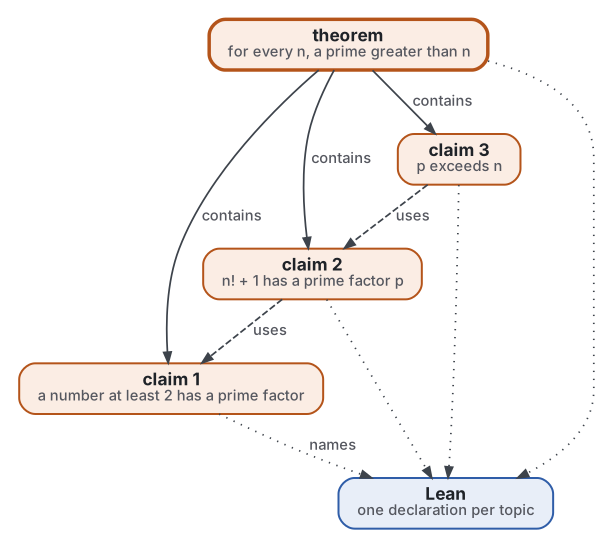
Graphviz source
digraph first_build {
  graph [rankdir=TB, nodesep=0.5, ranksep=0.5, bgcolor="white", pad=0.2, fontname="Inter"];
  node  [shape=box, style="rounded,filled", fontname="Inter", fontsize=13, margin="0.2,0.1", penwidth=1.5, fontcolor="#1F2328"];
  edge  [fontname="Inter", fontsize=11, color="#3D434B", fontcolor="#55575F", penwidth=1.3, arrowsize=0.8];
  T  [label=<<b>theorem</b><br/><font point-size="11" color="#55575F">for every n, a prime greater than n</font>>, fillcolor="#FBEDE4", color="#B4541A", penwidth=2.6];
  C1 [label=<<b>claim 1</b><br/><font point-size="11" color="#55575F">a number at least 2 has a prime factor</font>>, fillcolor="#FBEDE4", color="#B4541A"];
  C2 [label=<<b>claim 2</b><br/><font point-size="11" color="#55575F">n! + 1 has a prime factor p</font>>, fillcolor="#FBEDE4", color="#B4541A"];
  C3 [label=<<b>claim 3</b><br/><font point-size="11" color="#55575F">p exceeds n</font>>, fillcolor="#FBEDE4", color="#B4541A"];
  L  [label=<<b>Lean</b><br/><font point-size="11" color="#55575F">one declaration per topic</font>>, fillcolor="#E8EEF8", color="#2F5DA8"];
  T -> C1 [label=" contains"];
  T -> C2 [label=" contains"];
  T -> C3 [label=" contains"];
  C2 -> C1 [label=" uses", style=dashed];
  C3 -> C2 [label=" uses", style=dashed];
  C1 -> L [label=" names", style=dotted];
  C2 -> L [style=dotted];
  C3 -> L [style=dotted];
  T -> L [style=dotted];
}- Theorem and claims: the theorem, in
proofs/infinitely-many-primes/, holds three claims as its contents, one file each beside it. Each opens with a title and a summary, as every topic does. - Link to Lean: each topic carries one line,
**Lean:** \Blueprint.InfinitelyManyPrimes.``. - Lean project: a Lake project at the root, on Mathlib, its toolchain taken from Mathlib's tag.
- Three checks, three CI steps: the topic check;
checks/local/lean_link.py, which reads the Lean sources and the topics and compares the names;lake build, with Mathlib's cache.
Alternatives
| Option | Consequences | Why it lost |
|---|---|---|
| A longer theorem (irrationality of the square root of 2, a lemma of a course) | more claims, nearer to use | the build would test the theorem, not the pipeline |
| Core Lean without Mathlib | no cache to fetch, a fast build | the claims would be proved from scratch, and the miniature becomes a library |
One checker for link and build, in lake |
one step | a missing name and a failing proof are different findings; a program can say which |
| Match topic to declaration by file name | no **Lean:** line |
a rename of either breaks the link silently, and the line is what a reader sees |
Consequences
- Drawbacks: Mathlib is large, so a cold CI run is slow without the cache, and the Lake manifest pins one Mathlib version that a later bump must move.
- Risks: the link check reads names, not meaning. Nothing here shows that a Lean statement says what its topic says. That is the audit of B1, done by a person, and comparator does not replace it.
- Compatibility: the topic check and the standard's checks run unchanged on the new folder.
- Security: CI runs
lake exe cache getfrom Mathlib's public cache, and no secret.
Feasibility and plan
- Shown to work by: each claim is a one-line Mathlib lemma or close to it. The first build is checked by CI; it was not built on the machine that wrote it, whose Mathlib cache could not be fetched in time.
- Tested by: the topic check, unit tests for the link check, and
lake buildwithoutsorry. - Rolled out by: this design, the records, the proof as topics, the Lake project, the link check, the CI steps, in that order, one commit each.
Open questions
- Whether the link check should also read the declaration's statement, to show it beside the topic. Not decided.